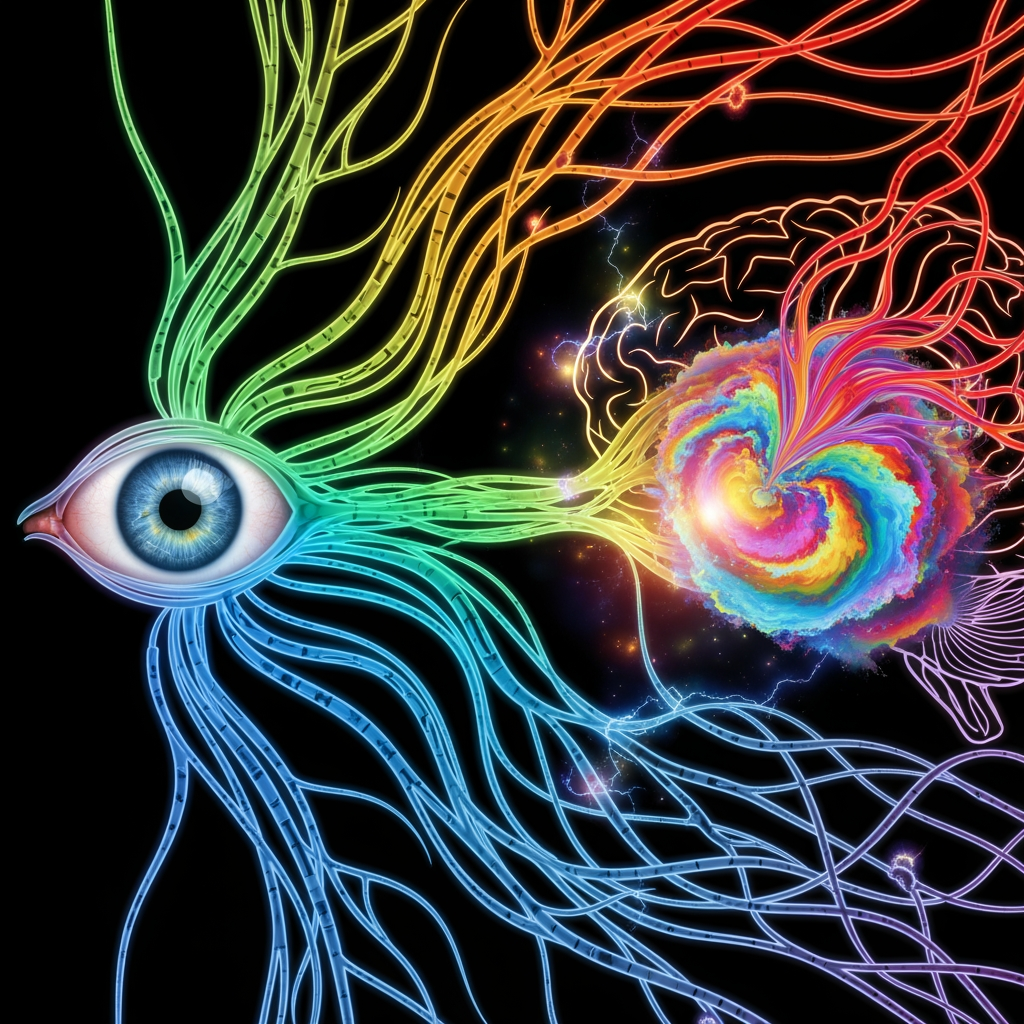
Color seems like a property of objects, but it's actually a construction of your brain interpreting different wavelengths of light. The process involves physics, biology, and neuroscience working together.
Light and Wavelengths
Visible light spans wavelengths from about 380 to 700 nanometers. Different wavelengths appear as different colors: short wavelengths look blue, medium wavelengths look green, and long wavelengths look red. White light contains all wavelengths mixed together.
The Cone Cells
Your retina contains three types of cone cells, each sensitive to different wavelength ranges. Short-wavelength cones respond most to blue light, medium-wavelength cones to green, and long-wavelength cones to red. Color perception emerges from the combined response of all three types.
Color Is Relative
Your brain interprets color based on surrounding context. The same wavelength can appear different colors depending on what's around it. This explains many optical illusions involving color perception.
Colorblindness
Most colorblind people have all three cone types but with altered sensitivity. Red-green colorblindness, the most common form, affects about 8% of men. Complete colorblindness, seeing only shades of gray, is extremely rare.
Why We See These Particular Colors
Evolution shaped our color vision to detect ripe fruit against green foliage and spot predators in varied environments. Other animals see different ranges—bees see ultraviolet, while many mammals see fewer colors than humans.
This article was generated by AI to provide informational content.